
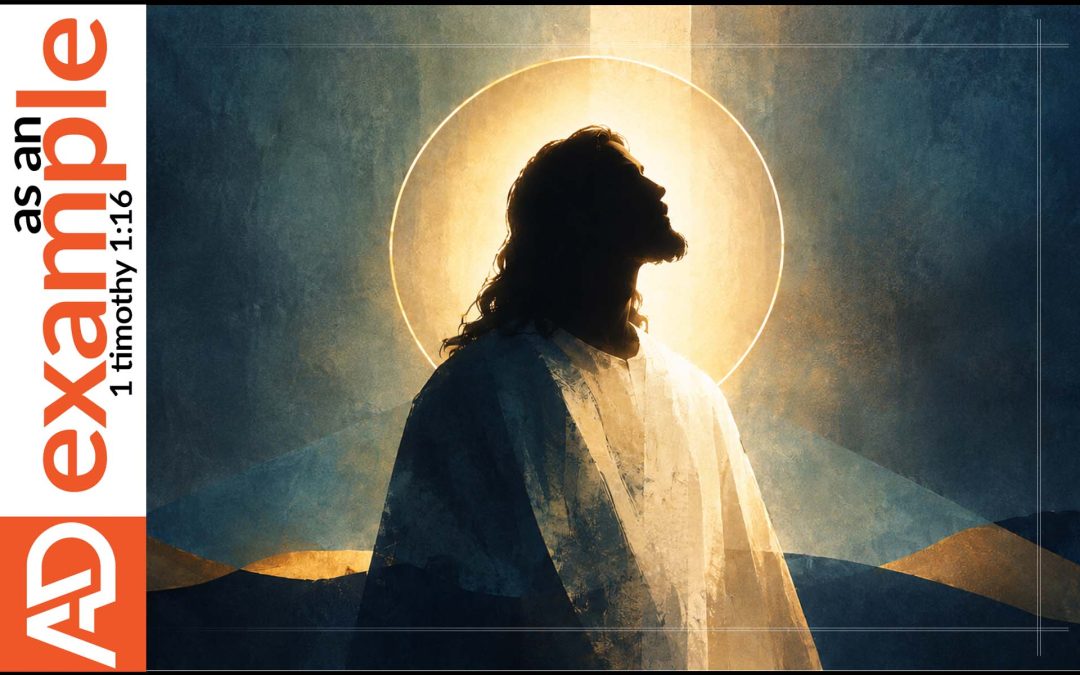
The Apostles’ Creed opens with a confession of God as Father, almighty, and creator, and then moves on to confess “Jesus Christ, his only begotten Son.”
By the term “and in,” the Creed carries forward the “I believe” with which it began. This is intentional: The creed is a single confession, not a menu from which we may pick the pieces we like. The trust we place in the Father is the very trust we extend to the Son. Some translations of the Creed even repeat “I believe” here to make the point more pronounced.
When the Creed confesses Jesus as the “Christ” and God’s “only begotten Son,” it confesses that he is the spirit-anointed one who eternally shares the Father’s own nature, not created but co-equal and co-eternal with him.
The anointed one
“Christ” is not Jesus’ surname. It comes from the Greek term Christos, which translates the Hebrew mashiach. It means “anointed one.” He is Jesus, the Christ.
In the Old Testament, three offices required anointing with oil: prophet, priest, and king. The Heidelberg Catechism, in Question and Answer 31, draws the conclusion directly. He is called “Christ” because he has been ordained by God the Father and anointed with the Holy Spirit to be our chief prophet and teacher, our only high priest, and our eternal king.
Scripture identifies him with each office. Peter, after the healing of the lame man at the beautiful gate, applies Moses’s promise to Jesus: “The Lord God will raise up for you a prophet like me from your brothers. You shall listen to him in whatever he tells you” (Acts 3:22; Deuteronomy 18:15). Hebrews cites the messianic psalm: “You are a priest forever after the order of Melchizedek” (Hebrews 7:17; Psalm 110:4). And Matthew shows him entering Jerusalem as the king of whom the prophet spoke, “humble and mounted on a donkey” (Matthew 21:4–5).
Each office has its function. The prophet is the voice of the Lord, and Christ perfectly reveals to us God’s secret counsel and will for our deliverance. The priest intercedes, going before a holy God in the place of the people, and the priest comes from among the people. That is why Hebrews 4 reminds us that we have a high priest who can sympathise with our weaknesses, having been tempted as we are, yet without sin. The Old Testament priests oversaw sacrifices that brought forgiveness, but they had to enter the Holy Place again and again. Christ entered once for all, by the blood of his own sacrifice. The king rules with authority and protects, governing us by his word and spirit and keeping us in the freedom he has won.
The lines between these offices were blurred even in Israel. Deuteronomy 17 has the king copying out the whole law, which is a priestly and prophetic task. Only in Christ, however, does one man, the God-man, hold all three offices perfectly.
Is Christ still our prophet?
A natural question arises. We can see how Christ is our priest and king today, but how is he our prophet now?
The answer is that he speaks through his word, applied by his Spirit. Jesus promised that the Spirit would bring to remembrance all that he had taught. The prophets of old never brought a new will of God; they called Israel back to the law already given. In the same way, when we receive Christ’s word through Scripture, illumined by the Spirit, we are not receiving something new, but we are receiving his prophetic word all the same. The offices overlap here too. The Word who was in the beginning upholds the universe “by the word of his power” (Hebrews 1:3), and in John 17 the great high priest prays, “Sanctify them in the truth; your word is truth.” The prophet’s word is the priest’s means of sanctifying his people.
Only begotten
The second title is “only begotten Son.” The Greek word behind it is monogenes, found in John 1:14, 18; 3:16; and 3:18, and traditionally rendered “only begotten.”
The difficulty lies with the English word. To the modern English ear, “beget” means to procreate as a father, or to produce as an effect or outgrowth. Both sound like making. Yet Christ was not made.
To see what monogenes actually means, look at the four places where it is used of someone other than Jesus. It describes the widow’s “only son” at Nain (Luke 7:12), Jairus’s “only daughter” (Luke 8:42), the man’s “only child” (Luke 9:38), and Abraham’s “only Son,” Isaac (Hebrews 11:17). Three observations follow. First, it always describes a child. Second, it conveys uniqueness of position rather than strict singularity (e.g. Isaac was not Abraham’s only son but was his unique son, the son of promise). Third, in every case, the child is dead or dying. The word heightens the tragedy: not merely a child, but the only one.
The core meaning, then, is uniqueness of relationship, not manufacture. That is why the ESV renders John 3:16 “his only Son,” and why the Latin of the Creed has simply filium unicum. The word “begotten” is not in the original Latin; it entered English through the Greek.
Yet the church had reason to keep the language of begetting. Against Arius in the fourth century, Nicaea confessed that the Son is “begotten, not made.” We want to convey not only uniqueness but also a sharing of the same being between Father and Son. As Scott Swain puts it, the Father–Son relationship is one between divine persons, not between a divine producer and a creaturely product.
So when a Christian confesses “only begotten,” he is not saying that Christ was made. Still, we should take care when speaking with unbelievers—perhaps particularly Muslims or Jehovah’s Witnesses—to stress that “begotten” describes a unique, eternal relationship within the Godhead. The Creed, moreover, is not inspired. It is a summary of Scripture, written for believers to affirm what they believe, and we must always return to Scripture to understand it.
Why it matters
Scripture itself rules out a created Christ. “In the beginning was the Word, and the Word was with God, and the Word was God…. All things were made through him, and without him was not anything made that was made” (John 1:1–3). “In the beginning” is pre-creation language. If every created thing was made through him, he cannot himself be a creature. Colossians 1 and Hebrews 1 say the same: He is the image of the invisible God and the exact imprint of his nature.
This is no mere technicality. No creature, however exalted, could bear God’s wrath against fallen humanity. Only God himself could drain that cup, and that is why the early church fought so hard for “begotten, not made.”
There is also a decision for us to weigh. We may keep updating our English translations to match contemporary usage, or we may retain the older wording and teach what it means. Either approach can be defended, we should think carefully about whether we say “only begotten Son” or “only Son” when we confess the Creed together.
The only Son, sent to die
Return, finally, to John 3:16: “For God so loved the world, that he gave his only Son, that whoever believes in him should not perish but have eternal life.” Every new testament use of monogenes describes an only child who is dead or dying, and here the word carries the same weight. There was no other child of God sharing his essence. Christ was the only one, and the Father sent him to die in our place.
To confess Jesus as the Christ is to confess the Spirit-anointed prophet, priest, and king, not a mere teacher or guru. To confess him as the only Son is to confess one who shares the Father’s own nature, eternally. This Christ demands our allegiance, which is where we will turn next time: to Jesus Christ, our Lord.