
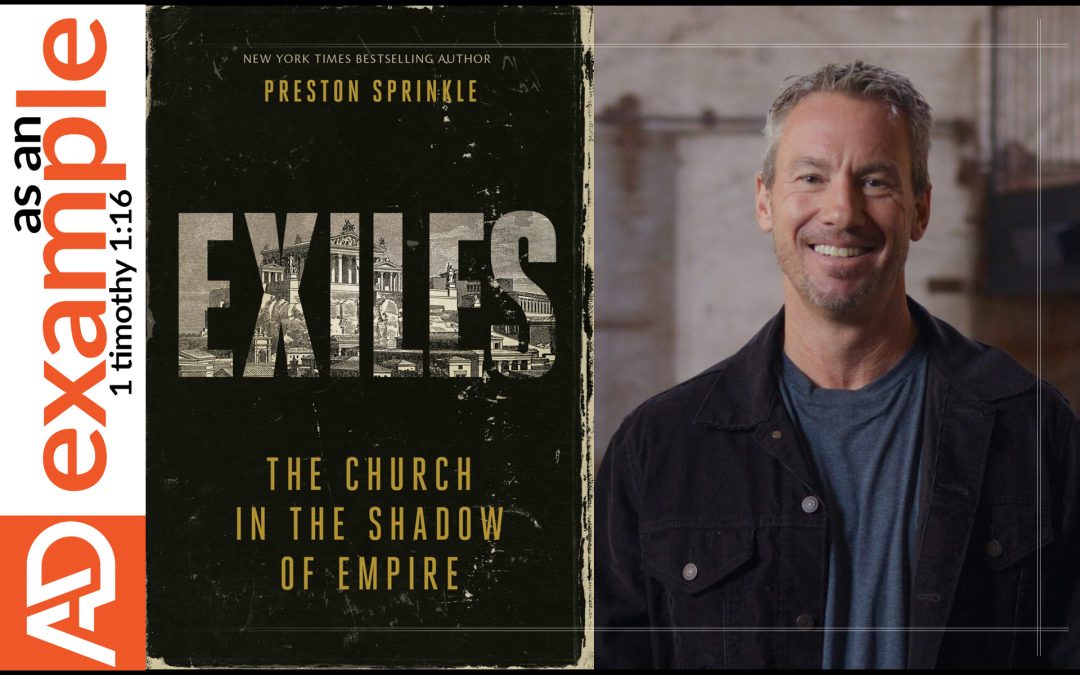
Anyone who has engaged with Preston Sprinkle for any meaningful amount of time will be familiar with his language of exile. He frequently speaks of Christians as exiles in a foreign empire who must root their allegiance firmly to Jesus Christ and his kingdom of light. Exiles: The Church in the Shadow of Empire is his most comprehensive discussion of the topic.
Throughout the book, he uses “Babylon” as symbolic of worldly, power-hungry empires. He bases this on the broadly held understanding that “Babylon” in the New Testament is a veiled reference to Rome. While I personally think that the New Testament writers used Babylon as code for Jerusalem rather than Babylon, his argument is not entirely dependent on that identification.
I’m first and foremost an exegete—an interpreter of Scripture—so this is the lane I want to stay in.
Sprinkle helpfully spends a good deal of time wrestling with the text of Scripture and seeking to root political thought and identity philosophically and theologically in the text. This is particularly beneficial when so many other treatments of the same subject matter jump directly to contemporary political issues. His approach, in this regard, is one of necessity. While he appreciates political theology, “I’m first and foremost an exegete—an interpreter of Scripture—so this is the lane I want to stay in.”
He also spends a fair amount of time discussing how the church in the early centuries viewed itself against the backdrop of the Roman Empire, which offers some interesting historical insight into how the Christians closest to the writing of the New Testament viewed their political allegiance.
Because his focus is biblical, rather than political, some might expect that he will have relatively little to say about politics. After all, religion and politics don’t mix, do they? He argues, however, that the New Testament is a highly political document, only not in the way that modern Westerners think of politics. Modern Westerners think of politics in terms of partisanship—left or right—but partisanship “divides the church, destroys our witness, and brings profound joy to the Devil, who’s always looking for creative ways to derail the kingdom of God.” Far from being an apolitical entity, the church roots its political identity firmly in allegiance to King Jesus. When Christians skew their allegiance, they skew their politics. The early church understood this, and the contemporary church desperately needs to return to this foundational understanding.
Deuteronomy 17 seeks to create an anti-kingly king stripped of all sources of pomp and pride. True power would come with living a humble life in submission to the real King of Israel.
Sprinkle begins by showing that Israel’s politics were deeply subversive to cultural norms. God’s directions for Israel’s king, for example, were laughable by ancient standards. Kings prided themselves on military might and political alliances, but God explicitly forbade that approach to kingship (Deuteronomy 17:14–20). “Deuteronomy 17 seeks to create an anti-kingly king stripped of all sources of pomp and pride. True power would come with living a humble life in submission to the real King of Israel.” He similarly shows how Israel’s approach to militarism, economics, and social class and power was deeply subversive to prevailing political wisdom.
The best way exiles can seek the good of Babylon is by living lives of submissive subversion, anticipating God’s future triumph over the beastly empires competing with his reign.
He then traces the theme of Babylon through Scripture and shows what it was like for ancient Israel to live under Babylonian rule. The prophets discouraged militaristic revolt and instead encouraged the people to pursue peace in exile, even as they remained loyal to God. Indeed, their pursuit of peace was intended as protest. Rather than seeking to violently overthrow the empire, they lived with the peaceable conviction that God’s kingdom would ultimately crush every other empire. “The best way exiles can seek the good of Babylon is by living lives of submissive subversion, anticipating God’s future triumph over the beastly empires competing with his reign.” Synagogues were formed during the exile as a form of protest to demands of ultimate allegiance to the empire. At synagogue, the Jews, removed from their homeland, openly displayed that they would not bow to the demands of the empire because they served a greater King. Similarly, our churches serve—or should serve—as a demonstration of ultimate allegiance.
Jesus came to establish a kingdom not of this world. His teaching and example embody a different kind of empire. The Sermon on the Mount, Sprinkle argues, is Christ’s constitution for his kingdom. Ultimately, Christ was crucified as a political revolutionary. But the early Christians took the very thing that the Romans believed had overthrown Christ’s kingdom—the cross—and turned it into the symbol of his power. And now Christ’s kingdom principles must guide our worldly political engagement. “We need to cultivate the habit of letting Christ’s kingdom and its ethic determine our political values, because Christ’s kingdom—and our membership in it—is a political identity.”
Sprinkle goes on to show that much of the language of the New Testament is deeply political. Terms like “saviour,” “shepherd,” and “father” were given to the Roman Emperor, but Christians applied these terms to their God to demonstrate that they had another Saviour, another Shepherd, another Father. “Christian” terms like “gospel” and “faith” were similarly lifted from political discourse and applied to Christ’s kingdom. Simply put, “the gospel is profoundly theological. It’s the means by which people get saved. But it also reconfigures our relationship to the empire by shifting our allegiance elsewhere.”
Sprinkle spends a chapter surveying Revelation’s approach to empire. He argues that the church’s approach to politics should serve as a gospel witness. He closes with a chapter addressing what a faithful approach to certain issues facing Christians today might look like.
In my assessment, the book is quite repetitive at points. I found myself speed reading through sizeable chunks of material that he had already addressed in preceding chapters.
When followers of the Lamb join the beast in an effort to transform society, they often end up looking more like a beast than a Lamb.
There are moments in which it might be argued that he seems to be writing inconsistently with his stated premises. For example, he spends a fair amount of time warning against using the political systems of worldly empire to achieve political goals. “When followers of the Lamb join the beast in an effort to transform society, they often end up looking more like a beast than a Lamb.” Instead, the church should “be the church” and effect change by the way of the cross. “If the church fails to embody the way of the cross—sacrifice, forgiveness, enemy love—in our pursuit of justice, then we declare to the world that Jesus and his kingdom are irrelevant for establishing justice in the world.” This is a challenge worth taking to heart. At the same time, his commendation of the civil rights movement in the very same chapter, which, it can be argued, utilised the power of the empire to affect change, seems at odds with his appeal.
Sprinkle hopes that the principles he addresses will apply to cultures beyond America, and, to a limited degree, they might. However, the book will definitely challenge mostly the American political context.
Ultimately, it’s a worthwhile read, though its repetitiveness, its tight American context, and its sometimes inconsistency knock a star or two from its final rating.

About the author
Dr. Preston Sprinkle is a biblical scholar, speaker, podcaster, a New York Times bestselling author, and is the co-founder and president of The Center for Faith, Sexuality & Gender, which equips Christians to engage questions about faith, sexuality and gender with theological faithfulness and courageous love. He is the host of the Theology in the Raw podcast and organiser of the annual Exiles in Babylon conference.