
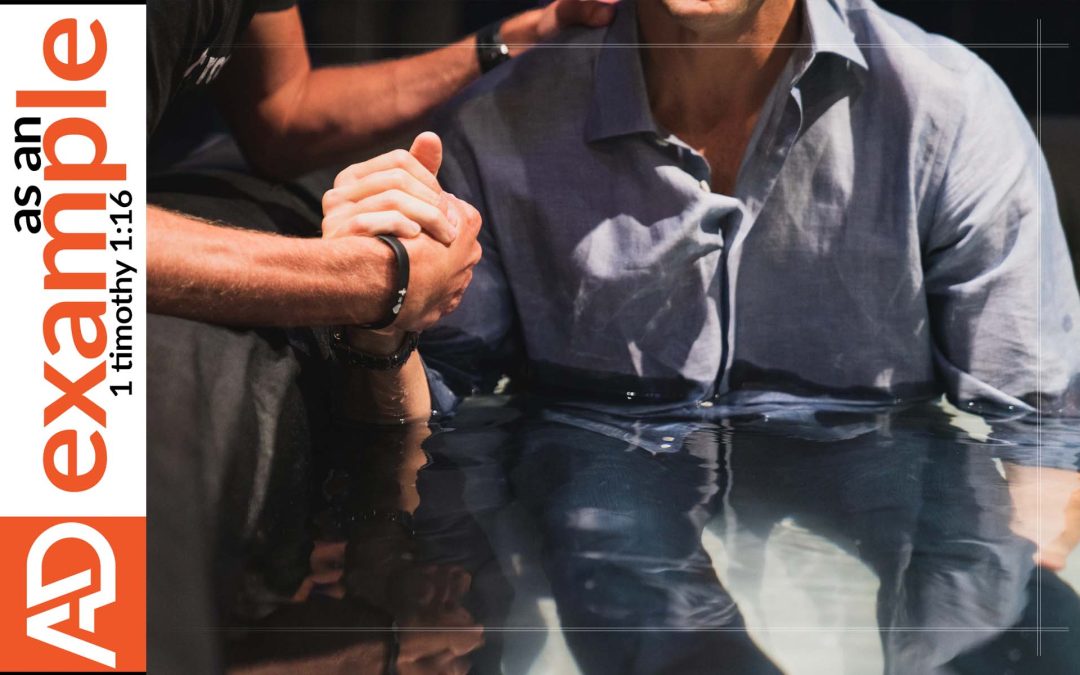
It is said that, when Martin Luther struggled with fear or despair, he would write on his desk, in chalk, baptizatus sum (“I am baptised”). He found strength and comfort in the thought of his baptism. Baptism was, as it were, an objective anchor against doubt and despair, a gift of grace not dependent on rhe subjectivity of his own faith. He could cling to the promises inherent in the act of baptism to give him hope in the face of despair.
Whether historically accurate or not, Luther’s story inspired Erdmann Neumeister, a Lutheran of a later era, to write a poem named for the slogan. The poem’s five stanzas pick up on promises intrinsic to the rite of baptism, which we do well to remember today.
Neumeister writes,
I am baptised into Christ!
He, because I could not pay it,
gave my full redemption price.
Do I need earth’s treasures many?
I have one worth more than any
that brought me salvation free
lasting to eternity!
When we are discouraged as Christians, we can allow our baptism to remind us of the gospel that purchased our salvation. Baptism points to the reality that we are children of God. We were “buried with him in baptism” and “raised with him through faith in the powerful working of God, who raised him from the dead” (Colossians 2:11–12). Baptism was not the instrument of our salvation—we were “raised with him through faith”—but our baptism served as a visible seal of this faith, and, in times of doubt, remembering our baptism reminds us of this.
Neumeister goes on:
I am baptised into Christ!
I have comfort even stronger:
Jesus’ cleansing sacrifice.
Should a guilty conscience seize me
since my baptism did release me
in a dear forgiving flood,
sprinkling me with Jesus’ blood!
Not only does baptism remind us that we are children of God; it reminds us that, as God’s children, we have been empowered to overcome sin. “We were buried therefore with him by baptism into death, in order that, just as Christ was raised from the dead by the glory of the Father, we too might walk in newness of life” (Romans 6:4). What does it mean to “walk in newness of life”? Paul explains: “We know that our old self was crucified with him in order that the body of sin might be brought to nothing, so that we would no longer be enslaved to sin” (v. 6). When tempted to sin, or tempted to despair by conviction of sin, let your baptism remind you that, in a dear forgiving flood, you were sprinkled with Jesus’ blood.
Neumeister’s third stanza reads:
Satan, hear this proclamation:
I am baptised into Christ!
Drop your ugly accusation,
I am not so soon enticed.
Now that to the font I’ve travelled,
all your might has come unravelled,
and, against your tyranny,
God, my Lord, unites with me!
Speaking of the reality that baptism pictures, Paul writes, “If we have been united with him in a death like his, we shall certainly be united with him in a resurrection like his. We know that our old self was crucified with him in order that the body of sin might be brought to nothing, so that we would no longer be enslaved to sin” (Romans 6:5–6). Baptism pictures the glorious reality that we have been set free from sin. When the world, the flesh, and the devil bring accusations against you, remember the promise of your baptism: You are no longer under sin. The accusation has no power over you. You have been united with Christ with the sure promise of eternal fellowship.
Neumeister continues:
I am baptised into Christ!
When I die, I leave all sadness
to inherit paradise!
Though I lie in dust and ashes
faith’s assurance brightly flashes:
Baptism has the strength divine
to make life immortal mine.
Since you have been united with Christ by faith, as publicly portrayed in baptism, the remembrance of your baptism should fill you with appropriate joy. Immortality is your certain inheritance because you are in Christ. What despair can possibly outweigh that?
Neumeister concludes:
to this lifelong comfort sure!
Open-eyed my grave is staring:
Even there I’ll sleep secure.
Though my flesh awaits its raising,
still my soul continues praising:
I am baptised into Christ;
I’m a child of paradise!
Baptism, properly understood, offers us great comfort. It is, as Calvin noted, “like a sealed document to confirm to us that all our sins are so abolished, remitted, and effaced that they can never come to his sight, be recalled, or charged against us.” He adds, “Therefore, there is no doubt that all pious folk throughout life, whenever they are troubled by a consciousness of their faults, may venture to remind themselves of their baptism, that from it they may be confirmed in assurance of that sole and perpetual cleansing which we have in Christ’s blood.”
May our baptism indeed confirm in us the assurance of full and final cleansing in Jesus Christ, the seal of the sure inheritance of eternal life.